
Why the Sokoto-Badagry Superhighway Matters for Agbara and Property Investors

·6 min read
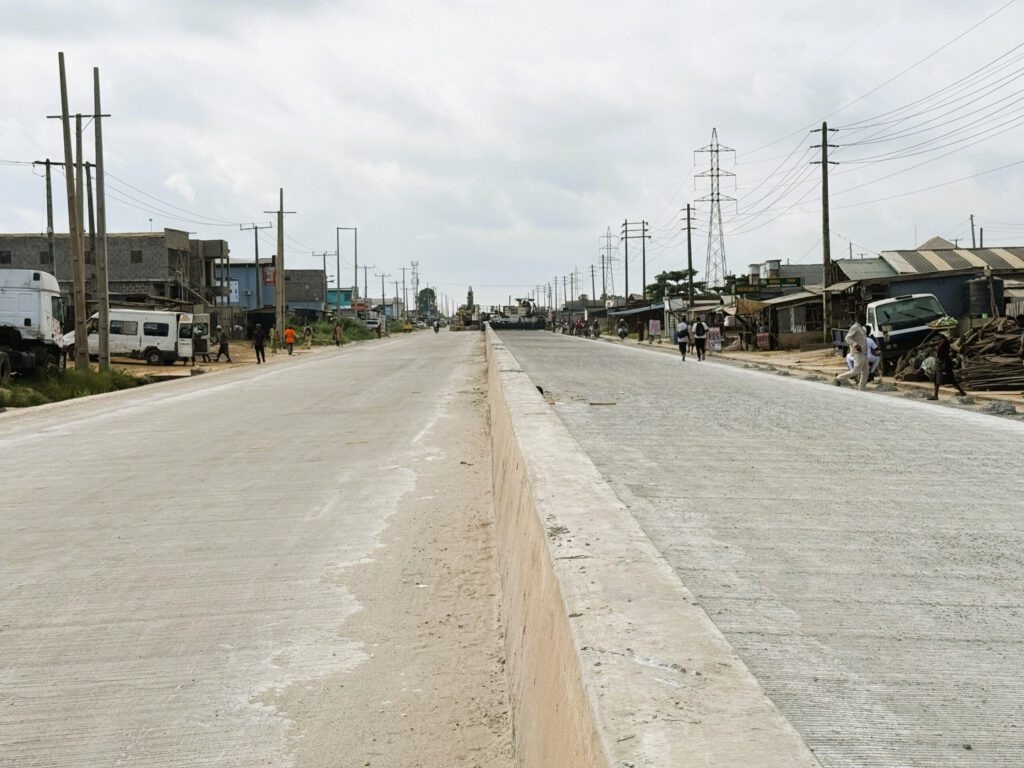
There is a stretch of federal road construction right now that most Lagos property buyers have never looked at closely. It runs through Ogun State, it is being built with concrete engineered to last a century, and its Section Three officially begins at Agbara Junction before terminating at the Ogun-Oyo boundary, 162.35 kilometres later.
That single fact, that a section of one of Nigeria’s most significant infrastructure projects starts at Agbara, is the reason early property investors are starting to pay closer attention to this corridor. And it is the reason Southfields Estate by Aspire Homes, a residential development inside the long-established Agbara Estate, is worth understanding now rather than after the road is finished.
What the Sokoto-Badagry Superhighway Actually Is
The Sokoto-Badagry Superhighway is a 1,068-kilometre federal dual carriageway — six lanes in key sections — designed to connect Illela in Sokoto State, on the Nigeria-Niger border, all the way down to Badagry in Lagos State. Along the way it passes through Sokoto, Kebbi, Niger, Kwara, Oyo, Ogun, and Lagos states, built using rigid concrete pavement technology intended to hold up for decades of heavy commercial and industrial traffic.
It is backed by serious federal financing. Nigeria’s House of Representatives approved a syndicated loan of over $516 million from Deutsche Bank AG for the project, alongside roughly ₦265.5 billion committed by the Federal Government for land acquisition and compensation along the route. Construction on Section Three began in November 2025, and site reports through early 2026 have shown consistent progress kilometres of earthworks, site clearance, and concrete casting moving steadily forward through the Ogun State axis.
For context, this is the same category of federal project that reshaped land values along the Lekki-Epe corridor years before most buyers noticed. Roads like this rarely announce their impact in advance. By the time it shows up in the news as a “hot corridor,” early positioning is already gone.
Why the Agbara Starting Point Matters
Here is the detail that changes the calculation for anyone thinking about property in this corridor: Nigeria’s Minister of Works, Dave Umahi, confirmed while inspecting the project that Section Three of the superhighway spans about 162.35 kilometres, starting from Agbara in Ogun State and terminating at the Ogun-Oyo boundary.
That is not a location loosely “along” the highway. That is the starting point of a federal section.
Infrastructure economics tends to follow a predictable pattern. Reliable roads improve accessibility, improved accessibility pulls in commercial activity and jobs, and that combination is historically one of the strongest signals of where property demands and property values head next. A location sitting at the origin of a federal highway section, rather than somewhere further along it, tends to benefit from that dynamic earliest.
Agbara is not a blank patch of land waiting to be discovered, either. It already has decades of industrial credibility behind it as the site of Agbara Estate, a 454-hectare integrated industrial and residential hub developed by LandAfrique Group that has hosted operations for Unilever, Procter & Gamble, and Nestlé since the 1970s. The superhighway is arriving in a corridor that already works.
Southfields Estate: A Residential Address at Agbara’s Front Door
Southfields Estate by Aspire Homes is the residential development arm of Agbara Estate Limited, built specifically within that same Agbara precinct. Meaning it sits at the same starting point as Section Three of the Sokoto-Badagry Superhighway, not several exits away from it.
The estate offers 2-bedroom and 3-bedroom bungalows designed for families, working professionals, and returning members of the Nigerian diaspora. Initial deposits start from ₦17.99 million for a 2-bedroom unit and ₦20.99 million for a 3-bedroom unit, with flexible payment plans stretching up to 18 months and full payment accepted in Naira, USD, or GBP. At this off-plan stage, buyers are securing units ahead of the pricing that typically follows once a project like this is closer to completion.
Every unit comes with verified land titles and transparent documentation. A deliberate answer to the title-related risks that are a common concern in the wider Lagos-Ogun property market, and one of the most frequent hesitations diaspora buyers raise before purchasing property back home.
Southfields Estate residents also benefit from infrastructure that is often promised elsewhere and rarely delivered on schedule: fully paved estate roads and drainage, fibre-optic broadband connectivity, 24/7 power from a gas-fired supply backed by solar, solar-powered street lighting, a central sewage and waste management system, and dedicated round-the-clock security patrols. These aren’t future upgrades. They are part of the current build.
Backed by the Agbara 2.0 Vision
Southfields Estate by Aspire Homes is being developed alongside Agbara 2.0, a broader upgrade to The Agbara Estate that includes a refurbished sewage treatment system, a 42MW gas-fired power plant supported by ongoing solar and waste-to-energy projects, improved internal roads and access systems, fibre broadband infrastructure across the estate, and estate-wide modern security systems.
In practical terms, this means anyone buying into Southfields Estate today is buying into a community that is already functioning and is simultaneously being renewed for the next phase of growth, with a federal highway section beginning at its doorstep.
The location also carries a strategic advantage beyond the superhighway itself. Agbara sits directly along the Abidjan-Lagos Expressway, connecting Nigeria to Benin, Togo, Ghana, and Côte d’Ivoire, positioning the corridor as a natural hub for regional trade and logistics as the Badagry-Sokoto Highway develops through it. Southfields Estate is also within reach of established institutions and commercial centres, including the Trade Fair Complex, Alaba International Market, Ojo Military Cantonment, Adeniran Ogunsanya College of Education, and Federal Government College, Ijanikin.
Is Now the Right Time to Look at This Corridor?
Every property decision should be grounded in personal research and financial planning rather than urgency alone. However the pattern is a familiar one to experienced Nigerian property investors: infrastructure investment, strategic location, and developer credibility are consistently among the strongest indicators of where a market is headed next, and all three currently intersect at Agbara.
Southfields Estate’s sales window and construction timeline are already moving. Sales launched in July 2025, and construction officially commences late 2026, with units expected to be ready for handover by December 2027. Buyers coming in during the off-plan stage are positioning ahead of that completion date, and ahead of a federal highway project that is expected to reshape the value of everything sitting at its starting point.
For Nigerians at home and in the diaspora considering their next property move, the relevant question is no longer whether Agbara’s profile will change over the next few years. It’s whether you’d rather read about that change after it happens or be positioned inside it before it does.
Explore Southfields Estate by Aspire Homes
A modern community carefully designed for families, professionals, and forward-thinking investors.
Click Here